Showing posts with label wildlife. Show all posts

Tuesday, November 1, 2011

Summer Reading

Two books that I read over the summer, and highly recommend:

Last Child in the Woods:  Saving our Children from Nature-Deficit Disorder, by Richard Louv

Changing Planet, Changing Health:  How the Climate Crisis Threatens Our Health and What We Can Do about It, by Paul Epstein and Dan Ferber

I have run out of free reading time outside course assignments at this point, but I will try to share interesting course readings this year as well.  There have been some great ones already in the first four weeks - in Environmental Economics, Ethics, and Corporate Environmental Strategy. 

Lots to think about, and maybe even to build a career around....

Friday, May 27, 2011

A visitor

May brought with it our first house guest from the U.S., which gave us our first significant motivation to get out and see the country of Israel.

After a day of adjusting to his 10 hour time difference, we took dad on a day trip up north.  We started with the Banias waterfall in the Galilee.  Although I managed to pack sandwiches, drinks, and bring the travel guides, I didn't think to look up the weather.  It was the first of May, so we're in the dry season, right?  As we got into the upper Galilee, it rained.  A lot.  And I didn't bring a raincoat.  We were in shorts.  And sneakers.  At the entrance to the waterfall trail, we saw the other tourists washing their shoes off.  We were in for a muddy trek!  Who would have expected thick, sticky mud on the trail in the middle east? 

Our second stop was the Nimrod Fortress. These relatively young ruins, from the Crusades during the 1200's, sat on a hilltop that was almost too cold to walk through!  We ventured on though, and were rewarded with very little company. This afforded us a particularly special opportunity to see some unusual wildlife.


At the far side of the castle, we first noticed these rodent-looking creatures similar to a racoon. But they had no contrasting colors, and no tails. There were dozens of them, and plenty of babies.

We finished the day with a late lunch / early dinner in a Druize village.  Humus with meat, falafel, tehina, grilled meats, pickles, pitas and lemonade with mint to wash it down.  We drove back south past the Sea of Galilee. 
Our second day trip was to Jerusalem and the Dead Sea.  I am very proud of this day, as I drove to, and into, Jerusalem.  Driving in New York City is a cake walk compared to this.  I managed to get us to a view point of the old city.  Dad and I walked around the sites that I have visited when I was out there with tour guides.  The coolest part wasn't showing him the holy sites, but taking him to a little hole in the wall for lunch.  It was a place a guide had showed me, where she went for lunch (instead of the overpriced, under quality touristy spots).  We finished the day with a trip to Kalia Beach at the Dead Sea.  This was dad's favorite part of the day, and honestly, I can appreciate that.  Jerusalem, for all it's hype, feels like most other historical places that have been overrun by capitalism.  Everyone is hawking something, and it's all junk.  And there are just too many people, even on a slow day like this one.  While I can appreciate the religious importance that others attribute to the place, I'd much rather go underground and the ruins of where and how people lived.  Unfortunately there is very little of the city accessible in this way, and none of it for free. 

Our third day trip was south toward the Negev desert.  We intended to make it all the way to the crater, about a 2.5 hour drive each way, but were so absorbed in the caves at the Bet Guvrin National Park that we ran out time to get there.  We really went back in time here, to about 300 B.C.  These caves were the homes of the Hellenistic people.  They dug levels down into the ground.  They had large water cisterns, huge pigeon breading rooms, and living space.  The room in the picture to the right was an olive oil processing room.  They have been producing the same food products in this region for literally thousands of years.  In fact, they still are.  We purchased several bottles from the kibutz that still works the olive trees in this area.

We also walked through the Roman ampitheater ruins in this area (built much later than the caves), and drove further south to the Zin Valley where I was last fall for the Deserts Conference.  I was able to show Dan and my dad the amazing valley and canyon here, although we were rushed out by a Park guard who clearly wanted to get off work early.  Even though we only had about a half hour in the park, we got to see an interested interaction between two young bedoin goat herders and the Park Ranger.  He was clearly giving them a hard time for crossing through park territory. 

Our fourth trip was to Caesarea, which I visited back in 2006.  This was a half day trip, the day after the crazy Independence Day party.  Dad and I walked through the park, which I remembered as being slightly more impressive than it seemed to me this time.  I don't know if it is the fact that I have seen ancient Roman ruins in many more countries now, or if tourism has diminished a bit of the mystery and sense of exploration in this place.

We finished the day with a stop at the ancient Roman aqueduct on the sea, having a snack while sitting on top of it, then walking along the beach next to it for 20 minutes or so.  Again, a pontentially moving place, but too many people to fully appreciate it.  These were locals however, not tourists like in the National Park.  It gave new meaning to "under the boardwalk," as in this case it was "under the ancient Roman aqueduct."  You can't experience that in America.
My final trip with dad was to Masada.  Dad was the one who noticed this one in the guidebooks.  I am really glad he did.  It was a hike - a little over a two hour drive each way, but worth it.  It is a 2,000+ year old fortress built on the top of a mountain in the desert, overlooking the Dead Sea.  We sprung for the cable car ride both ways, and were very glad we did.  We got our walking in on the top.  And there isn't much shade, so this is not a good spot to tour in the summer.  Plenty of people start before sunrise and hike up from below, which takes about an hour, they say.  I promise, if you come to visit, we'll take the cable car again.  :)

Like other national parks with ancient ruins, they have worked to rebuild parts to give a better sense of the layout.  Here they did something really helpful though, they drew a line along the walls showing what was found in place, and what was archaeologically rebuilt.  I appreciate this, as it can often be hard to tell what has survived and what has been re-created.  Although the the climate was quite different, it reminded me of my visit to Machu Pichu with my dad in 2000.  Here we were on another continent, on top of another mountain, looking at the ruins of an ancient culture.  I can't help wondering what the ruins of modern culture will look like in 500 years, or 2,000?

Tuesday, May 24, 2011

Gardening in the middle east

Spring has nearly come and gone.  

The fruit trees took a real beating over the winter.  The olive, as you can see, florished.  The bay leaf, lime, and finally the guava have put out lots of new foliage.  I'm still waiting to see whether my pomello is going to make a comeback, but I'm pretty sure I've lost the chezec (I got to eat this for the first time this spring - they look and taste a little like apricots, but have a group of large seeds inside instead of a pit).

Most of my herbs returned.  The basil died, so I put in a few new ones.  Lost one of those to over-watering, but the other is thriving.  My flowers are blooming like maniacs, and I have little green tomatoes all over the place. 
The humming birds are crazy.  They don't seek the feeder anymore, with all the flowers in bloom.  But they're here plenty, and always interested in a conversation. 
My biggest challenge right now is getting the right amount of water on each pot, because I've used up my little pots to add tomatoes, nastertiums and sweet peas.  The drip watering system that we pieced together (see the white plastic pipe at the base of the fence) sends the same amount of water out of each tube, so I would either need a lot more tubes for the big pots so I can scale back the amount of time it turns on each night, or I have to keep moving the little pots so they aren't over-watered.  I keep experimenting. 

Wednesday, March 30, 2011

Spring is for the birds

I've mentioned the two hummingbird pairs that come regularly to our patio.

Here is another interesting bird with a long tuft of feathers off the back of it's head, which has shown up this spring.  It has stripes on the body, and it pecks at the ground for bugs.  I've seen them in lawns around the city, including at Ulpan.

On highway 1, out toward Jerusalem, there is a radar station.  It's for monitoring the half a billion European birds that are migrating through Israel every spring and fall to get to Africa in the winter.  Birding is one of the most common reasons tourists visit here (I suppose religion still beats birding, but it's not far behind).

Wednesday, February 2, 2011

You won't see this in Israel

Driving up I-5 through Mt. Vernon, toward Bellingham, WA yesterday, I saw this on this lane in front of me.  For my Israeli readers who may have never seen this before, it's a logging truck.  They are so common in my mind, from my 18 years in Washington, that I wouldn't have given this a single thought before.  But having had conversations in Tel Aviv about the complete lack of such an industry (understandably given the environment), it caught my attention this time. 

Being away from the natural resources and beauty of the Pacific Northwest has made me acutely aware of how rich this area is.  Sure, it has rained about 50% of the days I've been here so far, but it's that rain that brings the forests, the snow on the mountain tops, and all the blueberries I can eat!

Friday, January 21, 2011

What a forest should look like


This, to me, is a forest.  Not those dry Israeli deserts with only short pines growing and nothing more than dry dusty earth under foot.

It's January here in Washington State, so it's not as green as when spring comes, but it's still relatively green.  Ferns, moss, honeysuckle, salal, knick knicks, orchids, pipsa-something-or-others - all kinds of little brush grows along the forest ground.  The lakes and streams are running fresh water and a misty rain falls nearly every day. 

Sure, it's cold, and who are we kidding, I've entirely lost my tolerance for that.  I'm wearing 3 layers just to avoid frost-bite in the house.  But once you get the layers on and get out along the trail, the air is so fresh, the sounds of water and birds so pleasant (especially the little kinglets high pitched chirp), and the wild animal markings so interesting (bobcat scratches on trees, coyote poop on the trail), what's not to love?

Saturday, January 8, 2011

After the Fire

 
During the week between Christmas and New Years, we decided to combine a few errands and take a day trip north to Haifa (about an hour drive up the coast).  This is the town that Dan lived in until he was 13 years old and moved to the States.  When he was young, his family and friends used to frequent the Carmel Mountains for picnics on weekends. 

Per a previous post, these mountains lit up in a record-breaking forest fire at the beginning of December, ushering in a very solemn start to Channukah.  It took international support to put it out.  But a bus load of prison guards got caught and died in the flames before they got there.  Our cousin even knew one of the young women who was on the bus.  Being in a small country, I have often found that someone we know has had a direct connection to events here like this.  That's obviously quite different than my experience with U.S. news which often feels remote. 

We drove out to the prison that sits among these hills (they call them mountains here, but compared to the Cascades in northwest U.S., well, there is no comparison).  As you can see from these pictures, the fire successfully devastated the trees.  Areas that were once picnic spots had only charred black spindles of branches left.  The facilities, once likely hidden nicely by the foliage now stuck out like a soar thumb on the hillside. 

The fire must have burned hot and moved fast, as you can see this pine cone got scorched, but still shows wood coloring on the inside. 

There has been talk in the news about the best strategy to renew the area.  Forest fires are of course a natural part of nature's process to destroy and renew itself periodically.  The question remains whether an area that has experienced such extremes (severe drout before the fire) needs a helping hand, or is better left to run it's course. 


Monday, December 13, 2010

Out with a bang

Well, I finally awoke to some patches of blue sky today.  The rain has been off and on, but the wind is calming down.

Everyone kept telling me this is what Israeli winters are like.  Just like they told me about the dry spells during Israeli summers.  Except this summer broke records, and now this winter is as well.  Finally a news article to corroborate my story - this weather is NOT normal.  There were 100 km/hr winds, and 10 meter waves.

What is that white stuff on the corner of my patio?  It's SNOW!  Yes, it snowed in Tel Aviv last night, and I have proof.  It also rained in my apartment.  That is to say, the roof by our kitchen sprung a leak and dripped down the wall, across the light switches and power outlet, culminating in a puddle last night.  I piled old rags around the wall to contain the drip, and luckily it subsided as the rain did this morning. 

Here's a YouTube Video (taken by someone else) from the southern end of Tel Aviv looking north along the coast....

Sunday, December 12, 2010

Will it ever end?

Well, I had to go out in it today. 

This morning was my first day back at Ulpan.  It was my first day wearing closed toed shoes to Ulpan.  And my first day taking a jacket.  I chose my light blue Helly Hansen windbreaker, as I had stepped out to secure patio furniture again and despite the wind, it was still fairly warm.
I took a detour by the beach to see the waves up close, but didn't go as close as I thought I might.  The wind was blowing so hard I had to brace myself against the rail to get a photo without blurring.

As I headed north I saw debris in all the nooks and crannies of buildings, sidewalks, and alleys.  I watched a large recycling bin blow off the sidewalk and into the road.  And the sidewalk around this building (pictured right) was cordoned off.  See all that stuff on the sidewalk?  Those are shards of wall tile that had blown right off the building!

Have to say, I'm glad I made soup yesterday.  The temperature has been dropping throughout today.  It's now 10 C /50 F.  And yes, I have finally turned the heat on.   

Saturday, December 11, 2010

And I thought yeterday was intense

I woke to grey skies today, and a howling wind outside. 

Then the storm showed up.  It has been blowing so hard that I can hear the patio furniture sliding around the deck above me from our office on the 5th floor.  When I went up to inspect, the sliding glass doors were flexing in the wind, some patio chairs had been flipped right over, and others were across the deck piled on top of each other.  The grill cover had blown clear off, and the plastic lid on the top of our recycle bin cracked clear away.  I went out and tucked a few things away between gusts, wondering if I might blow off the balcony in the process. 

I feel helpless watching my poor fruit trees struggle to keep their leaves.  I'm sure glad I have them all tied to the rail!

Usually our view of the Mediteranean Sea is calm and blue.  There are breakers that make the beaches calm, shallow, and crystal clear.  I'm not venturing to the beach until this storm dies down, but I can see from here how wild it is.  White caps are everywhere, and they are crashing way over the top of the breakers. 

Oh, and remember all that construction going on around us with the large swing-arm cranes?  Well, the one three blocks up the street from us is spinning in the wind like a flimsy weathervane!

Batten down the hatches guys!  It's a doozy.  Glad I have a bunker to retreat to.  ;)

Friday, December 10, 2010

A fleeting storm

They said it was coming, but I wasn't convinced.  A few minutes ago, it showed though!  Weather seems to come in extremes here, no matter what weather it is.  I heard the rain, saw the lightening, and then came thunder that put New England storms to shame!  As the chest-shaking rattle died down, the cries of the young children in nearby apartments picked up volume.  (We have a daycare nearby, as identified by the daily squeals of playtime, although I haven't actually seen it).  After four crashing rounds, and about 10 minutes of good rain, it's over.  Skies are clearing, and we may have sunshine again like we did earlier this morning.  It's a week late (could have used rain in the Carmel Forest last Friday), but I'll take it! 
Let it rain, let it rain, let it rain! (since snow is out of the question).

Thursday, November 18, 2010

Environmental Education Field Trip

On my last day at the Drylands, Deserts, and Desertification Conference, last Wednesday Nov 10th, I had the incredible opportunity to visit four sites just south of Be'er Sheva, where the Bedouin communities are exploring various types of environmental education and social empowerment. 

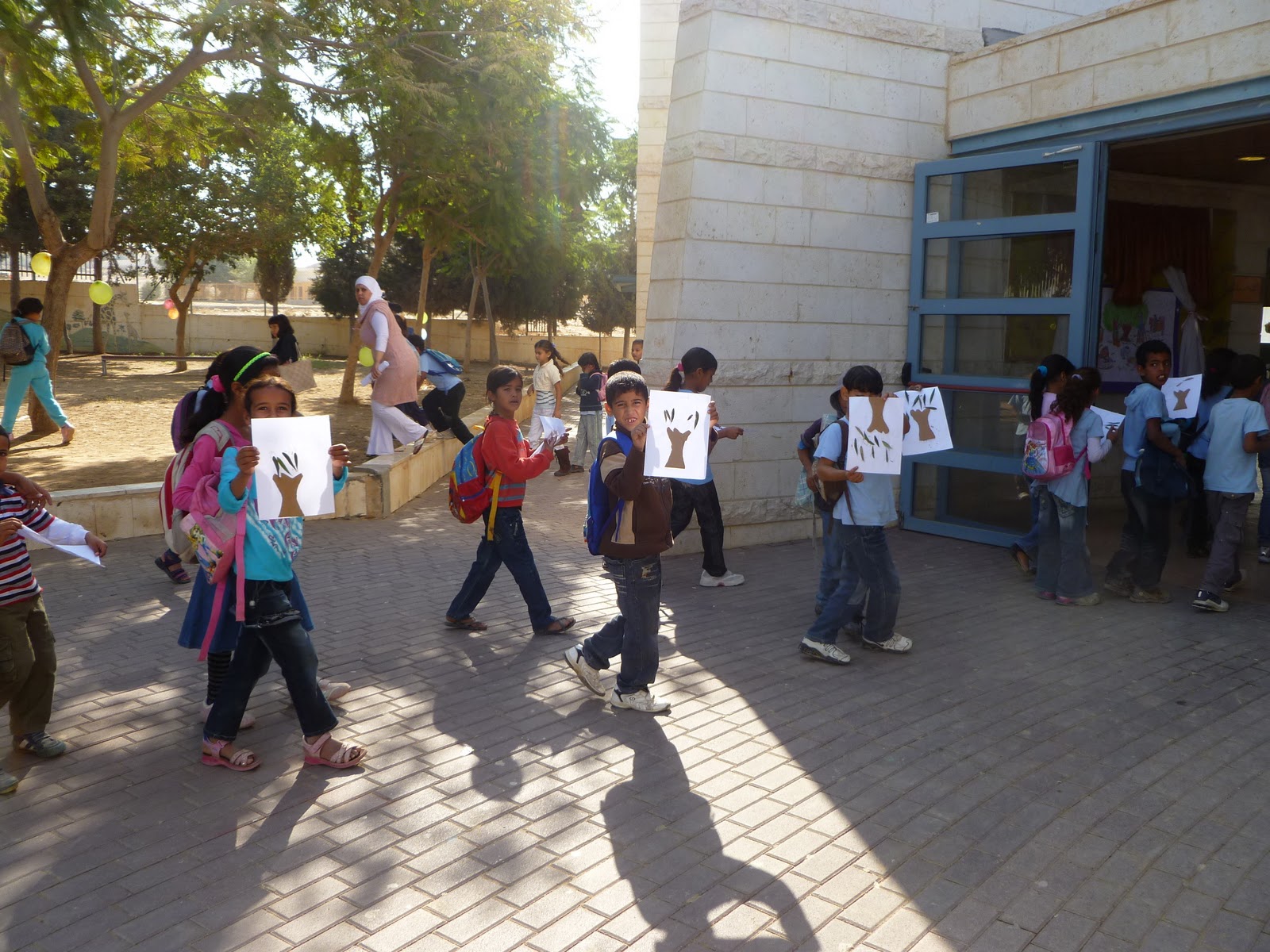
Our first stop was at the Segev Shalom Bedoiun School (see right).  Although you probably can't read it, the painting in blue expresses that this is an experimental school with experiential environmental education incorporated into everything that they do. It turns out we arrived on "Olive Picking Day," so the students were involved in activities tied to this (such as the olive tree collages in the second photo.)  At different points there were groups using the outdoor courtyards, as well as a full seating area for a class under the trees.  Another small group was making traditional coffee over a small open fire. 

We met with the Principal and learned the story of this place.  Twelve years ago, one of his teachers came to him and said, "I'd like to teach about the four seasons, but I do not have a lab."  His reply to her was, "You do not need one.  Take the students outside."  And so she did.  Upon her completion of her lesson, the Principal asked her how it went.  She told him about the success engaging the students directly in their environment, and said that she wanted to continue to incorporate this kind of learning into her curriculum.  So the students began spending part of their classroom time outside, and obvservations began to surface.  They noticed the large amounts of trash in their neighborhoods.  And they started asking questions of the traditional bedoins, such as, "why do you build your homes with goat hair instead of sheep? why do you build always with the door facing east?  why do you follow traditional says when you don't know what they mean?  And so the students began a discovery process, and what they learned they took back to those in their culture that had forgotten the reasons for tradition.  For instance, the bedoiun have a saying, "If you see a snake but don't catch it, don't worry, you can go to bed.  If you see a scorpion but don't catch it, do NOT go to bed that night."  Wondering why?  These kids discovered through their research that while snakes cover vast areas of land, scorpions are territorial, which means that if you didn't catch it, it's probably waiting under your pillow!
Because of their success developing new teaching methods, this school applied for experimental status 7 years ago.  However, a school can only maintain this status for 5 years, at which time they either need to revert to being a non-experimental school, or become a teaching/learning resource for other schools.  Two years ago they chose this path, and are spreading their experiential methods all around Be'er Sheva now.  Their intent is for the students to take home what they learn, teach their families, and develop a community consciousness of their connection to their environment. 
Our second stop was at a women's cooperative.  We met with the founder who started this project in 1996.  Before I explain what they do here, it is important to understand her story.  She was born to a family of nearly 10 children, as was her husband.  Bedoiun family tradition expects this, so much so that the Bedoiun population in Israel continues to double every 12 years!  Although we didn't learn what led to her unusual circumstance, she managed to meet and marry a man who wanted only 3 children.  She also wanted this.  She had two children, and when she got pregnant with her third, it turned out to be twins.  
She shared with us some of the traditional roles for women in Bedoiun society.  Women were responsible for building their homes, through careful construction via goat's hair fabrics.  Their embroidery work was their signature, used on their family and community's clothing, showing where they belonged and what their status was.  A large part of their day involved going to the community well, where women acted as the primary source of community communication, while men were out tending herds.  So as modernization came and the tribes became more stationary, most of the woman's crafting role disappeared.  They weren't building their new cement homes, clothes are machine made, and with running water, they lost their opportunity to connect with the community outside the home.

So this woman set out to create an enterprise that would fill some of these needs.  They produce the traditional embroidery of their culture, which can be done while home looking after their children, gives them a sense of community when they come in to exchange work, and an opportunity for educational meetings (like personal finance, health, etc) on these delivery days

Our third stop was at the solar powered village of Durigh'at.  Again, we met with the Principal of the school there.  His family leads this town of 80 families.  This town was a pet project of current President Shimon Peres, while he was Minister for the Development of the Negev, Galilee and Regional Economy.  It is one of many bedoiun villages that were not initially recognized by the Israeli government (usually due to disagreement over choice of location, from what I understand). 

So here's what happened in this village that ran on generators.  The government, who wouldn't hook them up to the utility lines, spent 1 million shekels (about $280,000) to outfit 20 homes with solar power.  Initially, the village was thrilled.  The idea was that then other families will see the benefit and purchase their own systems, for 48,000 shekels.  Five families have since done this.  But the rest are still using dirty old generators.  In the meantime, this project dropped on the governmental priority list.  The village is now in negotiations to get hooked up to the electric grid.  At this point, the Principal said if they don't do it, the village will ask for the supplies and do the work themselves.  Anyone who has spent time in the Peace Corps or knows someone who has, has heard stories like this. 

What was starkly absent to our visiting group of environmental education specialists, was the environmental education.  The Principal did not talk about any curriculum modifications surrounding this process, and there was a noticable increase in trash alongside the roads here, compared to the first school.  As we were hurried along for our next stop, I wondered if anyone had thought to get the Segev Shalom School together with this one here in Durigh'at.  The motivations and vision for the future here was at a much lower level of consciousness.  This Principal was proud of the handful of doctors and lawyers they had produced.  His focus is on bringing western prosperity to his community, with very little apparent thought about the ramifications of doing it without a systems approach. 

Our last stop was at a "green elementary school" in Arad.  Here we again met the Principal.  But his background was quite different.  He is an ecologist by training.  He came into his position about a year ago.  The current school was a combination of two previous schools, each with a focus.  One was the arts, the other was the environment, so now they work to incorporate both.  They work a lot with recycling concepts, using recycled materials from school or at home.  They built composters and plant gardens on campus.  The students were busy building outside classrooms with old tires and mud while we were there (see right). 

They also started a used clothing drive/store run by the kids.  One of the guides told of the response she got when she asked on a previous visit why the kids working in the store were sewing designs on the used clothes.  The boy's response, "sometimes it is uncomfortable for someone to see their classmate who donated the item they are wearing, so we change the clothes by sewing new details on them, making them new!"  Our final stop was in a classroom where a group was involved in a drama performance about recycling.  Before it started, the Principal opened the class discussion by introducing us, and letting our group ask questions.  One member asked, "what are you all doing?"  Half the little hands shot up in the air, butts nearly falling off seats, hoping to be called upon.  For the first time, I could understand the hebrew around me.  And the funniest part - one boy, who had been listening to all the English, and looked like one of the Ethiopian immigrants, answered back in English (the Israeli children don't learn English this young.) 

I left the group at this point, got a short ride to the bus stop, where I caught the bus to Be'er Sheva, about an hour.  Then I waited a half hour and caught a second bus from there to Tel Aviv, which took about another hour and a half.  It was an absolutely fabulous day! 

Tuesday, October 26, 2010

What flora can attract

There are plenty of pigeons and crows here, which quite frankly I could do without.  It's the little birds that have captured my attention.  There are the common chickadees and what look a bit like starlings.  But I am truly excited about the hummingbirds! 

Over the summer I saw pairs land on our balcony a couple times, so I finally had a chance to get out my hummingbird feeder last weekend.  I had a pair check it out within minutes of placement, but not a lot of interest it seemed. 

However, this morning, as we sat down for a quick breakfast, a bright shiny blue male came to survey the situation.  After a number of gulps, he flitted off.  Then a few minutes later his female mate came and did the same.  He came back again shortly after.  They've been at this for more than a half hour now. 

I've also seen a beautiful white crested bird that looked like a parakeet, from the window of my ulpan classroom.  And there was a speckled medium sized bird the flew past our balcony last week which I have not seen before or since.  Unfortunately, I have yet to capture these other ones on film, but here are a few of my little humming friends. 

In the top photo the male is at the feeder, and in the bottom one he's perched on top of my shesik fruit tree. 

What else do you see in the sky in the top photo?

Sunday, October 10, 2010

Fig, olive, lime, guava, pomello, chesic, and bay leaf

What do these tropical trees have in common?  They are all living on our patio now!  Friday afternoon Dan and I visited a nursery about 40 minutes north of Tel Aviv.  They had just what I was looking for to green our patio, and the staff was helpful beyond my expectations.  They spoke English!  The owners are German and Australian.  I was able to get 6 fruit trees, a large bay leaf bush, 20 herb starts, and at the owner’s recommendation, a strawberry start.  Who are we kidding, it didn’t take much arm twisting on that one.
They lasted exactly 24 hours in their new pots before the wind blew the pomello over and nearly snapped the trunk in half.  All trees are now securely tied to the rail in addition to the bamboo poles in the pots.   They said these trees are hardy and can withstand the sea winds here....I guess we're testing that theory out nicely now.


Tuesday, September 14, 2010

Ford Global Week of Caring

Yesterday Dan and I joined Triwaks, his PR firm here in Israel, to participate in an afternoon of community service, as part of Ford Motor Company's Global Week of Caring where over 11,000 employees and associates around the globe volunteer during company time. 

Triwaks organized an afternoon for us at the Tel Aviv Safari (zoo), where we met with the lead veterinarian, Dr Igal Horowitz, and worked with his staff to clean some large walk-in bird cages and then hang branches for the birds to swing on while they recover from surgeries. 

The animal hospital there was opened in the last 10 years, planning to see about 200 animals per year.  It now sees over 2,000 annually!  The vet said that awareness and attention to wildlife in Israel has grown exponentially in the past 12 years or so. 

Oh, and that little creature I found on the sidewalk a few weeks back - that was a hedgehog.  They are quite common here. 

Sunday, August 29, 2010

Left behind in Tel Aviv

On our walk back from dinner last week, we saw a little fuzzy lump on the sidewalk smaller than a softball.  Our first instinct was, "go around, it's a rat,"  but as we moved closer, it didn't move at all.    It was under a tree, so I wondered if it could be a baby possum.  But there was no tail.  Up close I could see a tiny pointy snout.  He was just curled into a little ball, and he'd move only slightly at the loud tap of a shoe, like he was startled.  But he wasn't otherwise going anywhere.  In case you're wondering, it was a baby porcupine.

Poor thing.  This isn't much of a picture, but it's all my phone could do in the dark, and I didn't want to keep traumatizing the little guy with the flash.