Showing posts with label volunteering. Show all posts

Saturday, May 28, 2011

Community giving in Israel

Just before Passover, I was walking past Rabin Square, where all major Tel Aviv city events have their epicenter.  This was the display - hundreds of empty shopping carts lined up on the square, under a billboard which encouraged Israeli's to donate food so that no family would go without meals during the eight day holiday. 

I have learned a little about local attitudes toward giving and fundraising engagement.  It exists.  But it doesn't sound like the runs/walks/drives are common here.  I'm not certain, but it doesn't sound like corporate fundraising teams exist here.  While a little can be fun and build a sense of community and shared purpose, it can also become so pervasive that people get sick of the "cause of the week" in the U.S. 

The non-profits I've met here struggle to find funding like everywhere else though, and the trend toward unchecked capitalism is invading non-profits just as it is in the U.S., so it will be interesting to see how the culture of giving progresses - will non-profits copy the U.S. model, or find their own path?

Thursday, November 18, 2010

Environmental Education Field Trip

On my last day at the Drylands, Deserts, and Desertification Conference, last Wednesday Nov 10th, I had the incredible opportunity to visit four sites just south of Be'er Sheva, where the Bedouin communities are exploring various types of environmental education and social empowerment. 

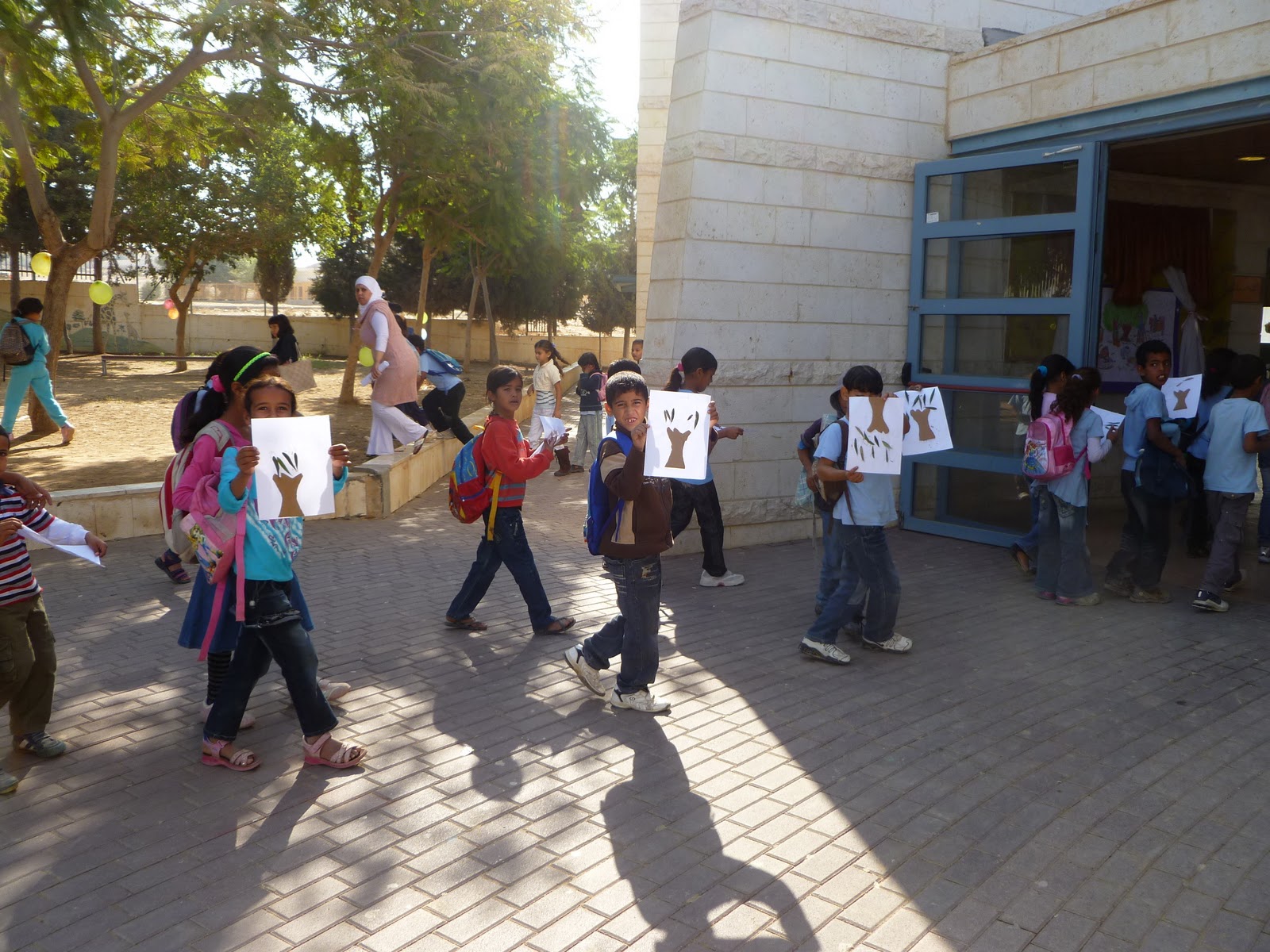
Our first stop was at the Segev Shalom Bedoiun School (see right).  Although you probably can't read it, the painting in blue expresses that this is an experimental school with experiential environmental education incorporated into everything that they do. It turns out we arrived on "Olive Picking Day," so the students were involved in activities tied to this (such as the olive tree collages in the second photo.)  At different points there were groups using the outdoor courtyards, as well as a full seating area for a class under the trees.  Another small group was making traditional coffee over a small open fire. 

We met with the Principal and learned the story of this place.  Twelve years ago, one of his teachers came to him and said, "I'd like to teach about the four seasons, but I do not have a lab."  His reply to her was, "You do not need one.  Take the students outside."  And so she did.  Upon her completion of her lesson, the Principal asked her how it went.  She told him about the success engaging the students directly in their environment, and said that she wanted to continue to incorporate this kind of learning into her curriculum.  So the students began spending part of their classroom time outside, and obvservations began to surface.  They noticed the large amounts of trash in their neighborhoods.  And they started asking questions of the traditional bedoins, such as, "why do you build your homes with goat hair instead of sheep? why do you build always with the door facing east?  why do you follow traditional says when you don't know what they mean?  And so the students began a discovery process, and what they learned they took back to those in their culture that had forgotten the reasons for tradition.  For instance, the bedoiun have a saying, "If you see a snake but don't catch it, don't worry, you can go to bed.  If you see a scorpion but don't catch it, do NOT go to bed that night."  Wondering why?  These kids discovered through their research that while snakes cover vast areas of land, scorpions are territorial, which means that if you didn't catch it, it's probably waiting under your pillow!
Because of their success developing new teaching methods, this school applied for experimental status 7 years ago.  However, a school can only maintain this status for 5 years, at which time they either need to revert to being a non-experimental school, or become a teaching/learning resource for other schools.  Two years ago they chose this path, and are spreading their experiential methods all around Be'er Sheva now.  Their intent is for the students to take home what they learn, teach their families, and develop a community consciousness of their connection to their environment. 
Our second stop was at a women's cooperative.  We met with the founder who started this project in 1996.  Before I explain what they do here, it is important to understand her story.  She was born to a family of nearly 10 children, as was her husband.  Bedoiun family tradition expects this, so much so that the Bedoiun population in Israel continues to double every 12 years!  Although we didn't learn what led to her unusual circumstance, she managed to meet and marry a man who wanted only 3 children.  She also wanted this.  She had two children, and when she got pregnant with her third, it turned out to be twins.  
She shared with us some of the traditional roles for women in Bedoiun society.  Women were responsible for building their homes, through careful construction via goat's hair fabrics.  Their embroidery work was their signature, used on their family and community's clothing, showing where they belonged and what their status was.  A large part of their day involved going to the community well, where women acted as the primary source of community communication, while men were out tending herds.  So as modernization came and the tribes became more stationary, most of the woman's crafting role disappeared.  They weren't building their new cement homes, clothes are machine made, and with running water, they lost their opportunity to connect with the community outside the home.

So this woman set out to create an enterprise that would fill some of these needs.  They produce the traditional embroidery of their culture, which can be done while home looking after their children, gives them a sense of community when they come in to exchange work, and an opportunity for educational meetings (like personal finance, health, etc) on these delivery days

Our third stop was at the solar powered village of Durigh'at.  Again, we met with the Principal of the school there.  His family leads this town of 80 families.  This town was a pet project of current President Shimon Peres, while he was Minister for the Development of the Negev, Galilee and Regional Economy.  It is one of many bedoiun villages that were not initially recognized by the Israeli government (usually due to disagreement over choice of location, from what I understand). 

So here's what happened in this village that ran on generators.  The government, who wouldn't hook them up to the utility lines, spent 1 million shekels (about $280,000) to outfit 20 homes with solar power.  Initially, the village was thrilled.  The idea was that then other families will see the benefit and purchase their own systems, for 48,000 shekels.  Five families have since done this.  But the rest are still using dirty old generators.  In the meantime, this project dropped on the governmental priority list.  The village is now in negotiations to get hooked up to the electric grid.  At this point, the Principal said if they don't do it, the village will ask for the supplies and do the work themselves.  Anyone who has spent time in the Peace Corps or knows someone who has, has heard stories like this. 

What was starkly absent to our visiting group of environmental education specialists, was the environmental education.  The Principal did not talk about any curriculum modifications surrounding this process, and there was a noticable increase in trash alongside the roads here, compared to the first school.  As we were hurried along for our next stop, I wondered if anyone had thought to get the Segev Shalom School together with this one here in Durigh'at.  The motivations and vision for the future here was at a much lower level of consciousness.  This Principal was proud of the handful of doctors and lawyers they had produced.  His focus is on bringing western prosperity to his community, with very little apparent thought about the ramifications of doing it without a systems approach. 

Our last stop was at a "green elementary school" in Arad.  Here we again met the Principal.  But his background was quite different.  He is an ecologist by training.  He came into his position about a year ago.  The current school was a combination of two previous schools, each with a focus.  One was the arts, the other was the environment, so now they work to incorporate both.  They work a lot with recycling concepts, using recycled materials from school or at home.  They built composters and plant gardens on campus.  The students were busy building outside classrooms with old tires and mud while we were there (see right). 

They also started a used clothing drive/store run by the kids.  One of the guides told of the response she got when she asked on a previous visit why the kids working in the store were sewing designs on the used clothes.  The boy's response, "sometimes it is uncomfortable for someone to see their classmate who donated the item they are wearing, so we change the clothes by sewing new details on them, making them new!"  Our final stop was in a classroom where a group was involved in a drama performance about recycling.  Before it started, the Principal opened the class discussion by introducing us, and letting our group ask questions.  One member asked, "what are you all doing?"  Half the little hands shot up in the air, butts nearly falling off seats, hoping to be called upon.  For the first time, I could understand the hebrew around me.  And the funniest part - one boy, who had been listening to all the English, and looked like one of the Ethiopian immigrants, answered back in English (the Israeli children don't learn English this young.) 

I left the group at this point, got a short ride to the bus stop, where I caught the bus to Be'er Sheva, about an hour.  Then I waited a half hour and caught a second bus from there to Tel Aviv, which took about another hour and a half.  It was an absolutely fabulous day! 

Tuesday, November 16, 2010

Drylands, Deserts, and Desertification Conference

On Sunday evening November 7th (my birthday), our bus load of participants drove down to the Sede Boquer campus of Ben Gurion University.  It was a 2 hour drive, punctuated by a stop in Be'er Sheva at a mall to buy dinner (not the best).

We arrived at about 8pm, well after dark.  After dropping eight participants at a hotel outside the campus which looked like a glorified motel complex (they used four locations for boarding the 600 participants from 65 countries), we arrived on campus at the field school housing (no better than the off campus options). 

We were greated by frantic 20-somethings, students and staff who were nearly as confused by what needed to happen as we were.  It took them about a half hour to track down all the room keys for the participants.  They could not answer basic questions about the campus, such as where/when breakfast was to occur the next morning, or whether there was internet access somewhere nearby (as there wasn't in the rooms).  Remember, these participants are experts in their fields from all over the world.  This was not their first conference, and I could tell they were more than a little frustrated by the lack of information and resources that enabled them to prepare for their speaking engagements in the following days. 

After about an hour and a half of trying to get participants settled, I was ushered onto the lap of one of the student coordinators in a tiny car full of oranges, pizzas, and more, with my suitcase in tow.  We drove to the one retail outlet in the area, a pizza joint, where we waited a half hour for them to bake 4 more pizzas.  Finally we drove to the student housing area where we met with the conference chairman.  He proceeded to provide the 20 or so student volunteers the structure for the upcoming day.  I asked about the possibility of getting a few basic resources for the participants, based on my observations earlier, including printed maps of the campus that they could use to get around.  I was brushed off in typical "don't bother me with the details" fashion, at which point I wondered if anyone was thinking about the details at all.

The student coordinator took me across the path to her apartment around 11pm (don't forget we had to be up at 6:30 to get the conference going the next day.)  Instead of finding the location where I was to stay, she insisted that I sleep at her place, in her bed (not with fresh sheets, mind you).  Although a very nice girl, she clearly hadn't the head for events management, appearing quite frantic, and insisting that she planned to stay up all night to everyone who would listen.  I gave up and tried to get some sleep in her bed, despite the chatter downstairs.  After 2 hours of restless sleep, I awoke to her coming in to bed herself, on our couch.  She said she found the key to my place, but at 2am I wasn't interested in searching for it in the dark.  Luckily though I was given another opportunity at 6am when her alarms started going off every 5 minutes for 20 straight minutes.  She was 5 feet from them, but didn't budge.  So I gave up, dressed, grabbed the key from the table, and went out to look for this illusive room. 

Rolling my little suitcase along behind me, I headed for the guard shack, hoping for help.  Unfortunately, they weren't even up at work yet.  While surveying my options in the intersection (north, east, south or west), I saw a guy a block down walking his dog.  I went up to him and tried my hebrew on for size, "eifo ha ___" and pointed to the sheet of paper with the info on it.  I was pleased to learn he knew exactly where to go, and he walked me there himself.  It turns out this room was in a small trailer, surrounded by other trailers, which I can only imagine became the cheapest, quickest way to house incoming research students on this tiny campus.  With my copy of a copy of a key that would sometimes take 5 minutes of attempts to unlock the door, I finally got in to discover a clean, never-before-used, mini apartment.  Perfect for a shower (and a nap later that day!)

The Conference opened with the Executive Secretary of the United Nations Convention to Combat Desertification, Luc Gnacadja.  I was excited for this section, hoping to learn a bit about the global strategies employed in this field.  My excitement ended in disappointment as his accent was so strong that he was hard to understand.  While there were translators for the participants listening with headphones, there weren't translators for the presenters, so the non-native English speaking presenters were really at a disadvantage trying to communicate their hypotheses and discoveries.

Despite the organizational challenges, there were some great presenters.  On Monday morning I attended the Public Health and Desertification session.  Professor Jonathan Patz of the Univ. of Wisconsin talked about the impact of the 3 degree Celcius increase in air temperative that the earth is currently undergoing in relation to public health.  Two examples that I had never considered really stuck with me.  Afterall, how could a slight temperature increase impact our health?  If anything, us northerners would be happy with a little less snow, right?  (Never mind the melting of the polar ice caps and rise in sea levels, but I digress).  Patz talked about the impact of 3 degrees on mosquitos.  Mosquitos are cold blooded, and thus take on the temperature of the air.  Any blood they suck will then also be air temperature.  When that blood carries malaria, it is now warmer which means it is less likely to remain dormant and quicker to spread.  A few degrees isn't a lot for a human, but it can be deadly via those pesky little mosquitos.  Second, with the temperature change we are seeing an increase in precipitation intensity (not volume).  This is leading to things like sewer overflows into places like Lake Michigan.  When tested, these waters have E. Coli and all kinds of little nasties, and guess what?  Our drinking water is being pulled right back out from these lakes.  Another very important point he made was that if you consider a more holistic view of the cost to convert to clean energy, it suddenly becomes a no-brainer.  Cities in the midwest U.S. showed a $4B healthcare cost savings by electing one day per week without driving (less polution, more exercise - kind of makes your head explode with the obvious simplicity of it).

In the Economic Development Strategies, Public Policy and Remote Sensing category, Alan Grainger from Leeds University talked about the World Forest Observatory, the first global monitoring system for the forest lands we have left.  Sounds crazy that we wouldn't have global monitoring systems by now (doesn't google monitor everything?) but it has been a real challenge create a publicly accessible data warehouse or wiki.  This one appears to be launching this year, however, and they hope it will lead to other global resources for gathering and monitoring data that spans the globe. 

In this same panel, I learned about two Israeli companies that have developed Concentrator Photovoltaics which significantly improve the efficiency of solar energy.  The companies are Zenith Solar and MST

During our Monday field trip, we visited a UNESCO world heritage site - the ancient Nabataean city of Avdat.  It was a major stop on the incense route from Asia for over 600 years B.C.  Continuing with the theme of the conference, we were shown their advanced agricultural techniques which allowed them security and prosperity with less than 8cm of rain per year, that hasn't existed in the area since.  While there, a military helicopter did several fly-bys and then hovered over us for a while (quite irritating when trying to listen to a speaker.)  This wasn't the last of the military operations overhead though.  There were planes rocketing overhead on a regular basis out there in the Negev.  Sadly, less than a week after the conference, a plane went down due to pilot error in practice, killing the 28 and 30 year old pilots.  It has been big news here.

The bottom picture here is the view from the field school in Sede Boqer.  I went out for a morning walk on Tuesday and ran into a family of mountain goats.  They were curious about me, but as long as I didn't get too close to the two young ones, the parents left me alone and continued along the edge of the cliff.   I didn't know what to expect in the "desert,"  but I was surprised by the large valleys.  I could never live in a place that dry, but it was definitely worth a visit!

Tuesday, August 24, 2010

The passion that Israel draws out

When we learned we were getting reloed, word spread like wildfire through our Israeli network.  If I had a dollar for every time I heard from someone about how much I'd love it here, I'd be able to work for free for the rest of my life.

It wasn't just Israeli's spreading the love.  The two outgoing Ford guys were genuinely torn up about having to leave. 

Tonight at happy hour in the hotel we met a US Air pilot who does the Philly-Israel run 3 times a month.  He's been doing it since they started the route, and he has built local contacts where he is getting involved in local projects during his off hours.  Stories like this are a dime a dozen here.  There's something about Israel that brings out people's passion - strong opinions, desire to come here, or to get involved in something. 

Do you have a story?  I'd like to hear.  Share it here via comment.