On my last day at the Drylands, Deserts, and Desertification Conference, last Wednesday Nov 10th, I had the incredible opportunity to visit four sites just south of Be'er Sheva, where the
Bedouin communities are exploring various types of environmental education and social empowerment.
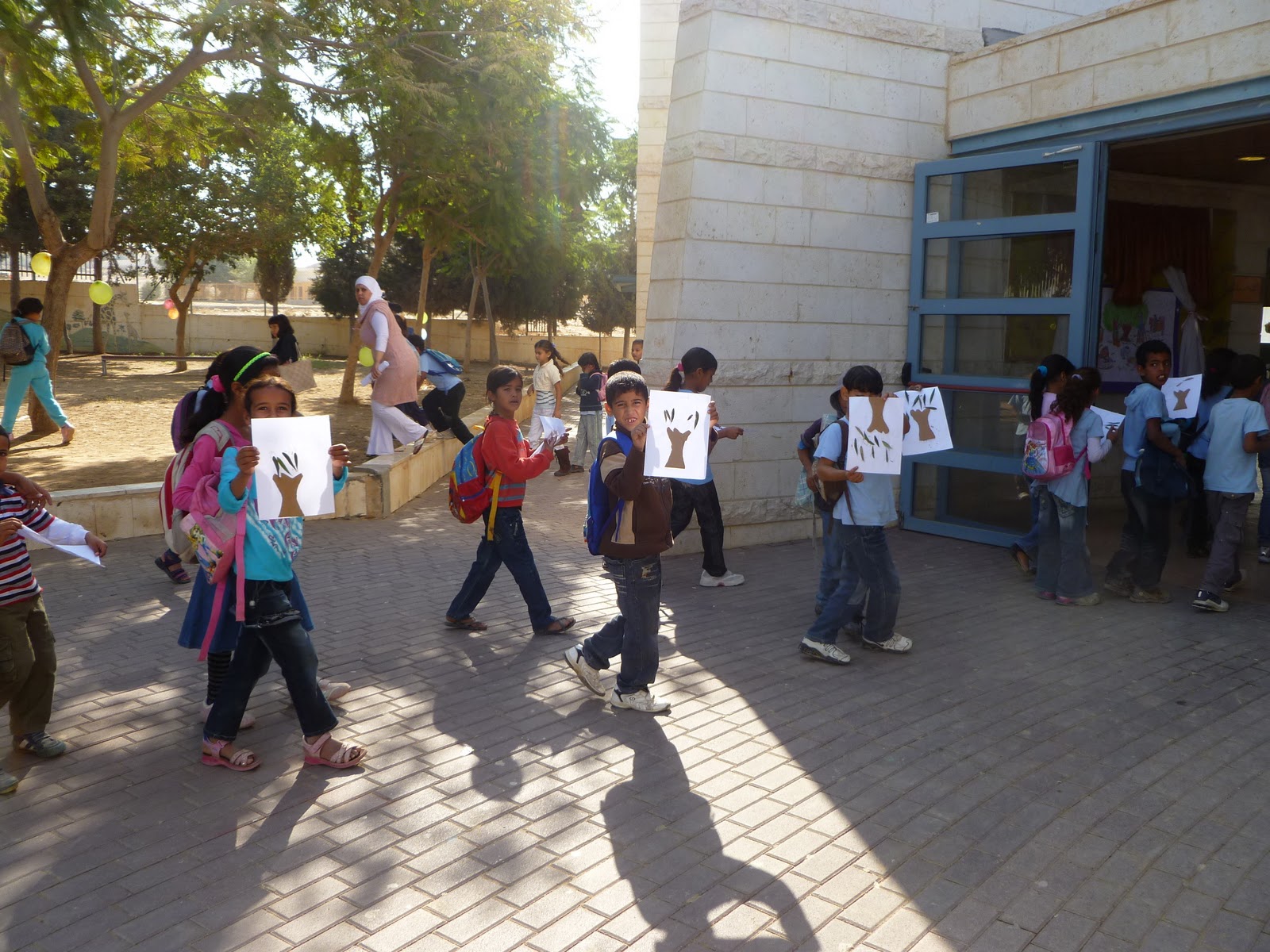
Our first stop was at the Segev Shalom Bedoiun School (see right). Although you probably can't read it, the painting in blue expresses that this is an experimental school with experiential environmental education incorporated into everything that they do. It turns out we arrived on "Olive Picking Day," so the students were involved in activities tied to this (such as the olive tree collages in the second photo.) At different points there were groups using the outdoor courtyards, as well as a full seating area for a class under the trees. Another small group was making traditional coffee over a small open fire.
We met with the Principal and learned the story of this place. Twelve years ago, one of his teachers came to him and said, "I'd like to teach about the four seasons, but I do not have a lab." His reply to her was, "You do not need one. Take the students outside." And so she did. Upon her completion of her lesson, the Principal asked her how it went. She told him about the success engaging the students directly in their environment, and said that she wanted to continue to incorporate this kind of learning into her curriculum. So the students began spending part of their classroom time outside, and obvservations began to surface. They noticed the large amounts of trash in their neighborhoods. And they started asking questions of the traditional bedoins, such as, "why do you build your homes with goat hair instead of sheep? why do you build always with the door facing east? why do you follow traditional says when you don't know what they mean? And so the students began a discovery process, and what they learned they took back to those in their culture that had forgotten the reasons for tradition. For instance, the bedoiun have a saying, "If you see a snake but don't catch it, don't worry, you can go to bed. If you see a scorpion but don't catch it, do NOT go to bed that night." Wondering why? These kids discovered through their research that while snakes cover vast areas of land, scorpions are territorial, which means that if you didn't catch it, it's probably waiting under your pillow!

Because of their success developing new teaching methods, this school applied for experimental status 7 years ago. However, a school can only maintain this status for 5 years, at which time they either need to revert to being a non-experimental school, or become a teaching/learning resource for other schools. Two years ago they chose this path, and are spreading their experiential methods all around Be'er Sheva now. Their intent is for the students to take home what they learn, teach their families, and develop a community consciousness of their connection to their environment.

Our second stop was at a women's cooperative. We met with the founder who started this project in 1996. Before I explain what they do here, it is important to understand her story. She was born to a family of nearly 10 children, as was her husband. Bedoiun family tradition expects this, so much so that the Bedoiun population in Israel continues to double every 12 years! Although we didn't learn what led to her unusual circumstance, she managed to meet and marry a man who wanted only 3 children. She also wanted this. She had two children, and when she got pregnant with her third, it turned out to be twins.
She shared with us some of the traditional roles for women in Bedoiun society. Women were responsible for building their homes, through careful construction via goat's hair fabrics. Their embroidery work was their signature, used on their family and community's clothing, showing where they belonged and what their status was. A large part of their day involved going to the community well, where women acted as the primary source of community communication, while men were out tending herds. So as modernization came and the tribes became more stationary, most of the woman's crafting role disappeared. They weren't building their new cement homes, clothes are machine made, and with running water, they lost their opportunity to connect with the community outside the home.
So this woman set out to create an enterprise that would fill some of these needs. They produce the traditional embroidery of their culture, which can be done while home looking after their children, gives them a sense of community when they come in to exchange work, and an opportunity for educational meetings (like personal finance, health, etc) on these delivery days

Our third stop was at the solar powered village of Durigh'at. Again, we met with the Principal of the school there. His family leads this town of 80 families. This town was a pet project of current President
Shimon Peres, while he was
Minister for the Development of the Negev, Galilee and Regional Economy. It is one of many bedoiun villages that were not initially recognized by the Israeli government (usually due to disagreement over choice of location, from what I understand).
So here's what happened in this village that ran on generators. The government, who wouldn't hook them up to the utility lines, spent 1 million shekels (about $280,000) to outfit 20 homes with solar power. Initially, the village was thrilled. The idea was that then other families will see the benefit and purchase their own systems, for 48,000 shekels. Five families have since done this. But the rest are still using dirty old generators. In the meantime, this project dropped on the governmental priority list. The village is now in negotiations to get hooked up to the electric grid. At this point, the Principal said if they don't do it, the village will ask for the supplies and do the work themselves. Anyone who has spent time in the Peace Corps or knows someone who has, has heard stories like this.
What was starkly absent to our visiting group of environmental education specialists, was the environmental education. The Principal did not talk about any curriculum modifications surrounding this process, and there was a noticable increase in trash alongside the roads here, compared to the first school. As we were hurried along for our next stop, I wondered if anyone had thought to get the Segev Shalom School together with this one here in Durigh'at. The motivations and vision for the future here was at a much lower level of consciousness. This Principal was proud of the handful of doctors and lawyers they had produced. His focus is on bringing western prosperity to his community, with very little apparent thought about the ramifications of doing it without a systems approach.

Our last stop was at a "green elementary school" in
Arad. Here we again met the Principal. But his background was quite different. He is an ecologist by training. He came into his position about a year ago. The current school was a combination of two previous schools, each with a focus. One was the arts, the other was the environment, so now they work to incorporate both. They work a lot with recycling concepts, using recycled materials from school or at home. They built composters and plant gardens on campus. The students were busy building outside classrooms with old tires and mud while we were there (see right).

They also started a used clothing drive/store run by the kids. One of the guides told of the response she got when she asked on a previous visit why the kids working in the store were sewing designs on the used clothes. The boy's response, "sometimes it is uncomfortable for someone to see their classmate who donated the item they are wearing, so we change the clothes by sewing new details on them, making them new!" Our final stop was in a classroom where a group was involved in a drama performance about recycling. Before it started, the Principal opened the class discussion by introducing us, and letting our group ask questions. One member asked, "what are you all doing?" Half the little hands shot up in the air, butts nearly falling off seats, hoping to be called upon. For the first time, I could understand the hebrew around me. And the funniest part - one boy, who had been listening to all the English, and looked like one of the Ethiopian immigrants, answered back in English (the Israeli children don't learn English this young.)
I left the group at this point, got a short ride to the bus stop, where I caught the bus to Be'er Sheva, about an hour. Then I waited a half hour and caught a second bus from there to Tel Aviv, which took about another hour and a half. It was an absolutely fabulous day!

 Then we took a break to visit the local market with Yui, where we purchased some of the ingredients that are hard to find in western grocery stores - palm sugar and sticky rice (we bought kaffir lime leaves later in our trip). Something I had never noticed before in a market (but have since) is that they bundle soup mix ingredients for sale, just like can be found in U.S. grocery stores. However, these soup mixes are small rubber-banded bunches of lemongrass, galangal, and kafir lime leaves.
 Upon our return to the classroom, we made our own spring rolls and finished off the day with mango and sticky rice.




 Posts
Posts


